Climate-action research · October 2026–Present
Climate Action Lab
Connecting reliable sources with practical climate questions.
01 · Purpose
A starting point for climate action
The broader research asks how AI can help people find practical actions suited to their location and circumstances. My prototype gives that work a concrete starting point: a collection of climate legislation, organizations, and public resources.
02 · My role
Make scattered sources usable
Working with Professor David Rand and Gabriela Czarnek, I investigated databases of actions, bills, and advocacy groups. I organized sources by geographic coverage, update frequency, and how a chatbot could use them. Mikayla Gray contributed source-credibility checks and help obtaining Congress.gov API access, and has joined the collaboration with the team’s approval.
03 · What I built
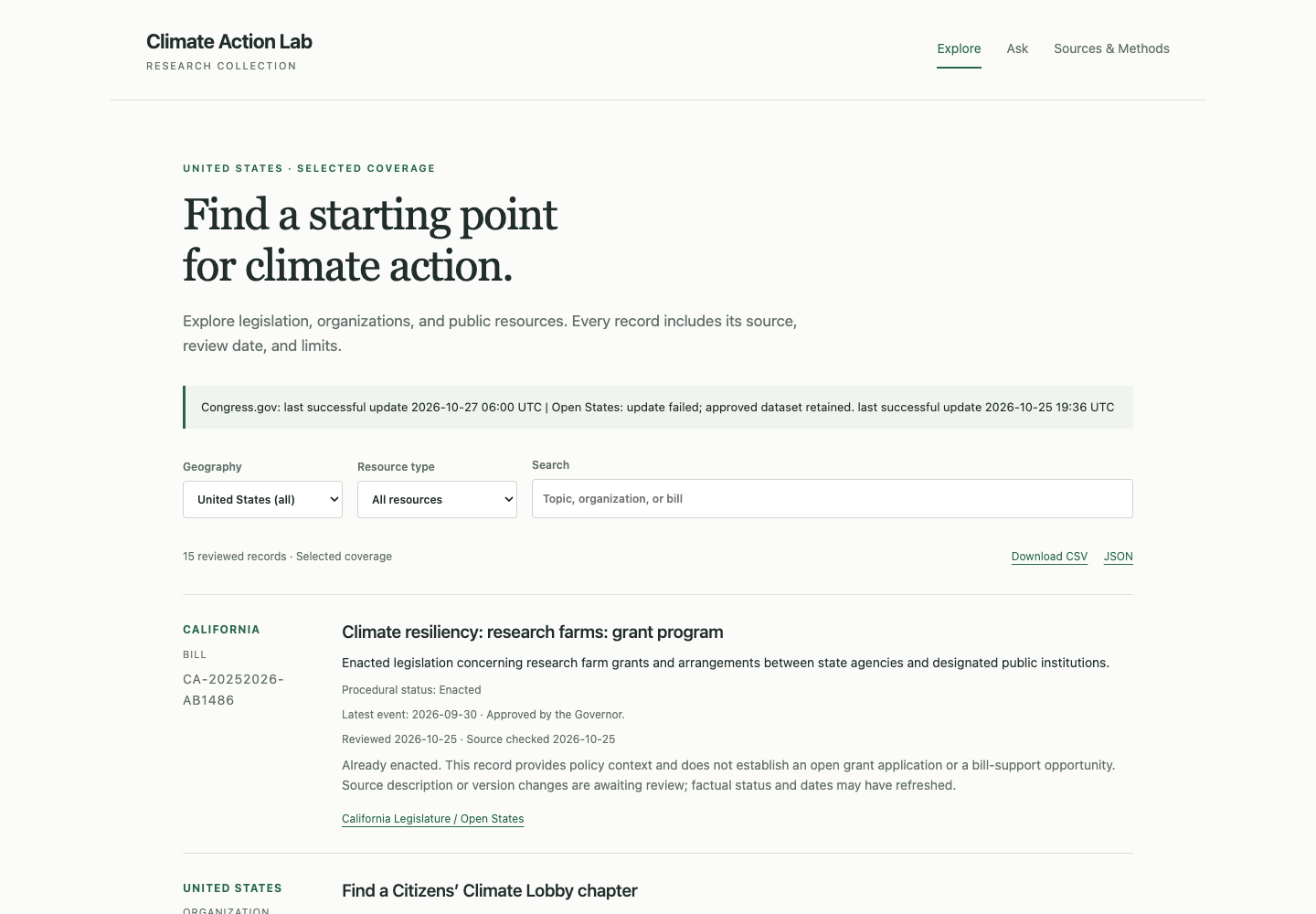
A reviewed collection and a source-based assistant
I built and shared a public website with geographic and resource filters, CSV and JSON downloads, and an assistant that points users to reviewed sources. Congress.gov and Open States supply legislative data; newly discovered records go through human review before publication.
04 · Design decisions
Make the evidence and its limits visible
The prototype displays source links and coverage limits, keeps new discoveries in a review queue, and falls back to source lookup when an AI response cannot be validated. I raised privacy and trust questions about how personal information would be handled and whether people would feel comfortable sharing enough for useful recommendations. I also proposed readable interfaces, concise questions, and attention to retention and repeat use. These are design considerations; I have not measured improvements in those outcomes. The prototype does not establish complete national or local coverage.
05 · Current stage
From source collection to recommendation review
I shared the first version with the research team in October 2026. Gabriela endorsed Project Drawdown as a dataset source. The next assigned evaluation is to fact-check AI-generated climate-action recommendations across California, Massachusetts, Florida, and West Virginia. The supplied ChatGPT dialogues keep the household profile constant—a person who believes in human-caused climate change, has a young family, drives, eats a typical American diet, and uses ordinary appliances—while changing location to the Bay Area, Cambridge, Orlando, and West Virginia.
- Check that links work and point to the correct resources.
- Verify that suggested programs are active and available to local residents.
- Assess factual accuracy and consistency with other climate-action resources.
The review is intended to identify gaps by geography and type of action, helping the team decide which information belongs in the database. Checking specific legislation and elected representatives is a possible follow-up. An Environmental Defense Fund contact also recommended Rare’s behavior-focused climate report, recent peer-reviewed work on household emissions, and tools that could support localized recommendations. These are research leads, with suitability still to assess. Evaluation results have not yet been reported. The broader lifestyle-personalization system is still research in development; this prototype does not establish measured behavior change or Cornell University endorsement.