Technical contribution
Sensor and camera deployment support, environmental data integration, monitoring workflow design, field troubleshooting, and technical documentation.
Case study · IoT + field systems
A low-cost monitoring workflow designed around the realities of moisture, power, connectivity, propolis, and the need to turn readings into decisions.
01 · The problem
Commercial hive systems can be expensive and rigid. DIY systems can fail under moisture, power loss, signal blockage, and noisy sensor output. The project’s goal was not to collect the most data; it was to produce reliable signals that could support less invasive hive stewardship.
02 · My contribution and ownership
At Capitol Bee Care, I supported sensor and camera deployment, data logging, and monitoring-workflow design, working alongside people with beekeeping experience to connect each technical choice to real conditions in the hive.
Sensor and camera deployment support, environmental data integration, monitoring workflow design, field troubleshooting, and technical documentation.
Placement, intervention thresholds, and reliability decisions were informed by beekeeping practice and real deployment constraints.
03 · Architecture
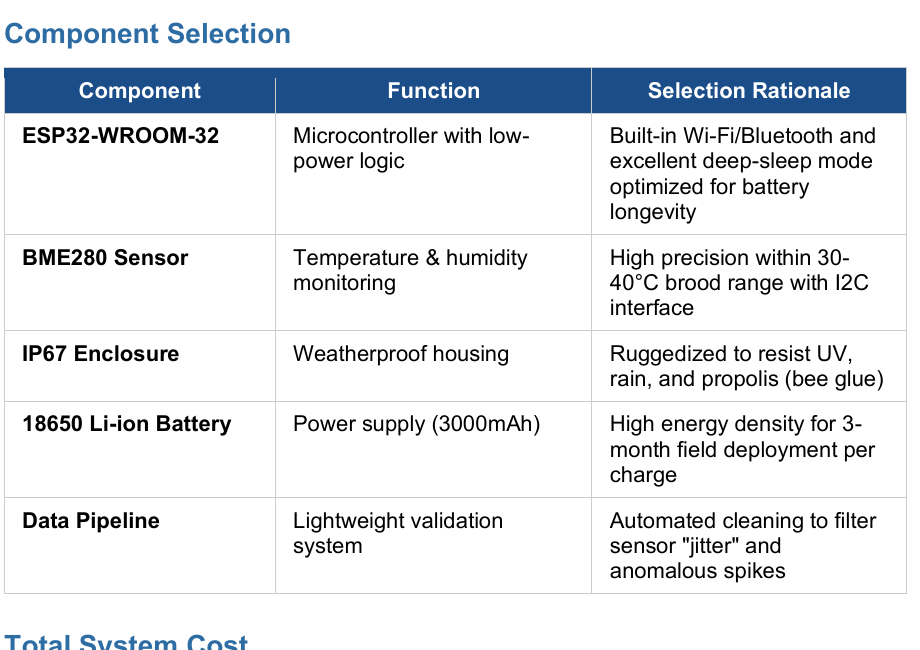
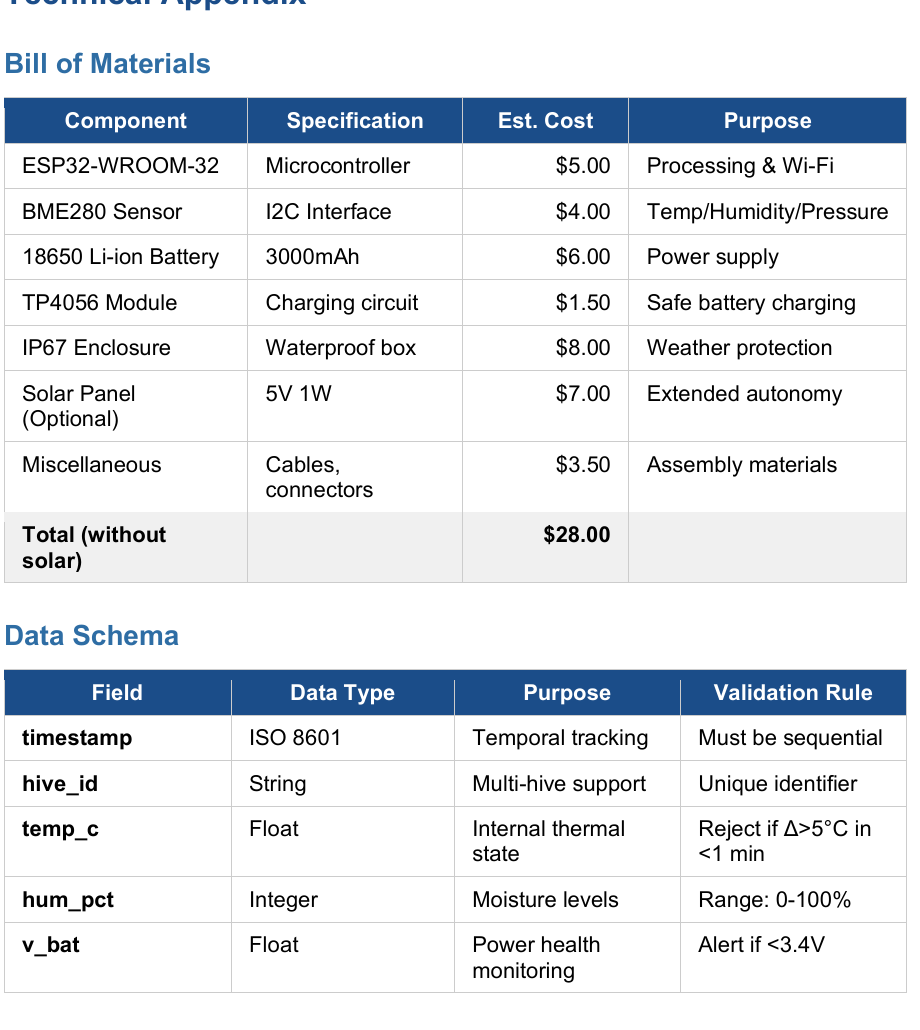
Each part below traces back to a specific field requirement — power budget, weather exposure, or data reliability — rather than a spec sheet chosen for its own sake.
 Enlarge image ↗
 Enlarge image ↗
04 · From readings to action
A raw sensor reading becomes a usable signal only after it passes through four layers of processing, each one removing a different kind of noise.
Level 1
The ESP32 takes sequential readings and uses the median to reduce transient spikes from brief disturbances.
Level 2
The device wakes on an interval, connects, transmits a processed packet, and returns to low-power operation.
Level 3
Temperature and humidity are evaluated over time so normal daily fluctuation is not confused with an intervention signal.
Decision layer
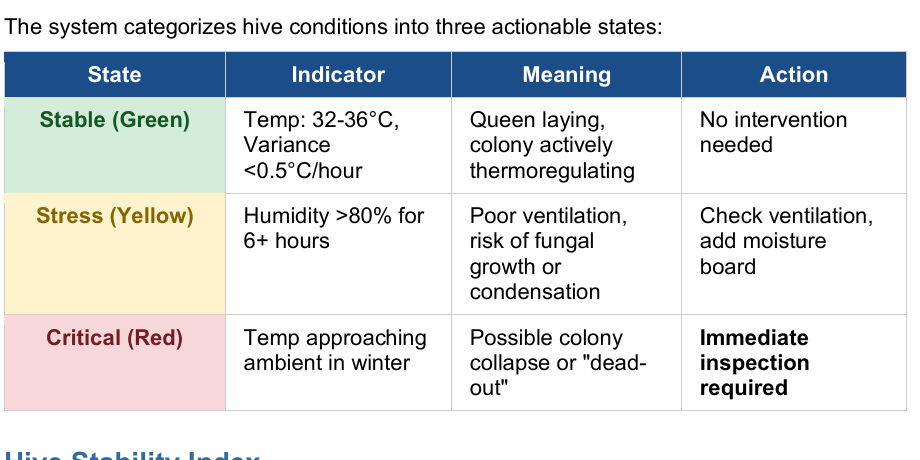
Conditions are translated into stable, stress, or critical states with a corresponding beekeeper action.
 Enlarge image ↗
05 · Field iteration
No single fix solved the reliability problem. Placement, power, moisture, and signal integrity each needed their own answer, and the four had to hold up together in the field.
Sensors were positioned near the brood-box thermal core while avoiding the entrance, airflow blockage, and colony disruption.
Sampling intervals and deep-sleep behavior were used to extend feasible deployment time between maintenance visits.
Coating, sealing, and an IP67 enclosure addressed corrosion and water ingress.
External antenna placement and filtered readings addressed hive-material interference and transient noise.
06 · Reported pilot outcomes
The 2025 project report records these pilot results. A public raw dataset and independent validation are not available.
07 · Limits and next work
08 · Artifacts